The Chefs Larder is the chefs canvas, where we develop our love of haute cuisine into a fulfilling dining experience.
Based in the West Coast of Scotland, we have a passion for all culinary aspects, from foraging, preparation, creating dishes and of course tasting the final flavours.
Our blog welcomes you into our kitchen, where we hope to showcase everything from special dishes, recipes, trade secrets, events, reviews and everything haute!

@thechefslarder

Monday, 28 April 2014

Rabbit Pappardelle with Truffle Pecorino Cheese

Pasta dough:

550g pasta flour
4 eggs
6 yolks
Pinch salt
15ml saffron water
15ml olive oil

4 rabbit legs
500ml duck fat
50g truffle pecorino
30g butter
Salt
Lemon zest

First season your rabbit legs and place into the duck fat in a heavy bottomed oven dish and confit at 85*c for 8 hours. If you don't have 8 hours then you can do it while your at work, don't worry at that heat they can't burn. In the kitchen, we prefer to do them over night so they're ready to pick as soon as we start in the morning. You'll know when they're ready as the meat just falls off the bone without any force. Pick out the bones & cartilage and discard. This meat holds a little longer than meat thats braised or roasted, so any extra can be kept to have with your lunch the next day.

For the pasta dough you'll need to pile all the flour onto a spacious work bench and make a well in the middle to hold the liquids. Mix all the remaining ingredients together and place into your flour well. With a pastry cutter (or your hands) start mixing the flour into the liquid to produce a rough dough, this should take around 5 minutes. Start to kneed the dough like a bread dough until it is fully incorporated, don't over work it tho. Wrap in cling film and rest in the fridge for an hour.

When rested, roll out your dough slightly with a rolling pin, Start on number 10 on your pasta machine and pass through the dough, this recipe is decent enough so its not too wet, or dry, which means you wont need to play about with loads of flour. Every time you put the pasta through, turn it over and place the opposite end into the machine so your producing and even size pasta. The format goes as follows:

10: twice
9: twice
8: twice
Fold in two and repeat 8 twice
7: twice
6: twice
5: twice
4: twice
3: twice

We only go as far down as 3 because we want a bit of body to our pasta, if you go much further then the sheets become too thin to work with and often break.


Flour your pasta sheets, fold them up and cut into desired strips. We're doing pappardelle which is the width if your thumb but you could do it as wide as you like. Boil a pot of water and throw in a small handful of salt then blanch your pasta for 1 minute then refresh in ice cold water  you can of course just heat the pasta from dry when your crating the dish but I feel this gives it a longer yield if you're wanting to keep some in the fridge for later.

In a hot pan, place in your rabbit meat, butter and a drop of the pasta water to make a sauce, not too much tho as its salty. Add a small amount of lemon zest and some Pecorino, the cheese is important, as most of the flavour derives from its use. Heat the pasta for 2 minutes and mix with your rabbit in the pan. Finally garnish with grated pecorino and a small pinch of herbs. We are using mizuna in this dish but it can go with chive, tarragon or parsley.
Sounds harder than it is, honestly..

Find us on Facebook or @thechefslarder

Wednesday, 23 April 2014

The French Food & Wine Club

Recently we attended our first meeting of The French Food & Wine Club. After recently picking up a business card from the Beaumartin Deli on Great Western road, we decided to tag along. 

The tasting evening was arranged to taste two fantastic French products, the first, Crémant de Bourgogne, a fine sparkling Burgundy and Crottin De Chavignol, a goats cheese produced in the Loire Valley. 


The Crémant de Bourgogne was smooth, light and crisp on the palate. The light acidity of the wine gave it a tasteful length, that complimented the goats cheese perfectly. Due to the appellation not been based in the Champagne region, the price is not as high as its established cousins. Meaning this delicately produced wine comes in at an affordable price. 


The Crottin de Chavignol was served to us in two ways; fresh and dried. The fresh cheese was subtle, and unobtrusive when paired with the wine. A beautiful smooth texture that was popular with all. The older, drier wheel was, understandably a more powerful version of the fresh cheese. Firmer and more dough like, the dried cheese proved more of a hit with the group. 


The relaxed and free flowing atmosphere of the group meeting made this an enjoyable evening, and we were even given the chance to win a bottle of the fantastic Crémant, sadly it wasn’t us this time, but we’ll be back to try again.

For more info:
www.ffwc.co.uk
Or, check them out on Facebook


Tuesday, 8 April 2014

Scallop Roe Velouté

A great shellfish sauce using the leftover roe's that are far too often thrown out. This one may be best used in a professional kitchen, do the quantity of roes used, unless you can cut a deal with your local fishmonger for something special to produce at home.


Recipe:

4 sliced shallots
1 clove
1 star anise
4 garlic clove
50g butter
50ml olive oil
100ml white wine vinegar
300ml white wine
Pinch saffron
30 scallop roes
500ml fish stock
500ml double cream
200ml milk
A punch of salt

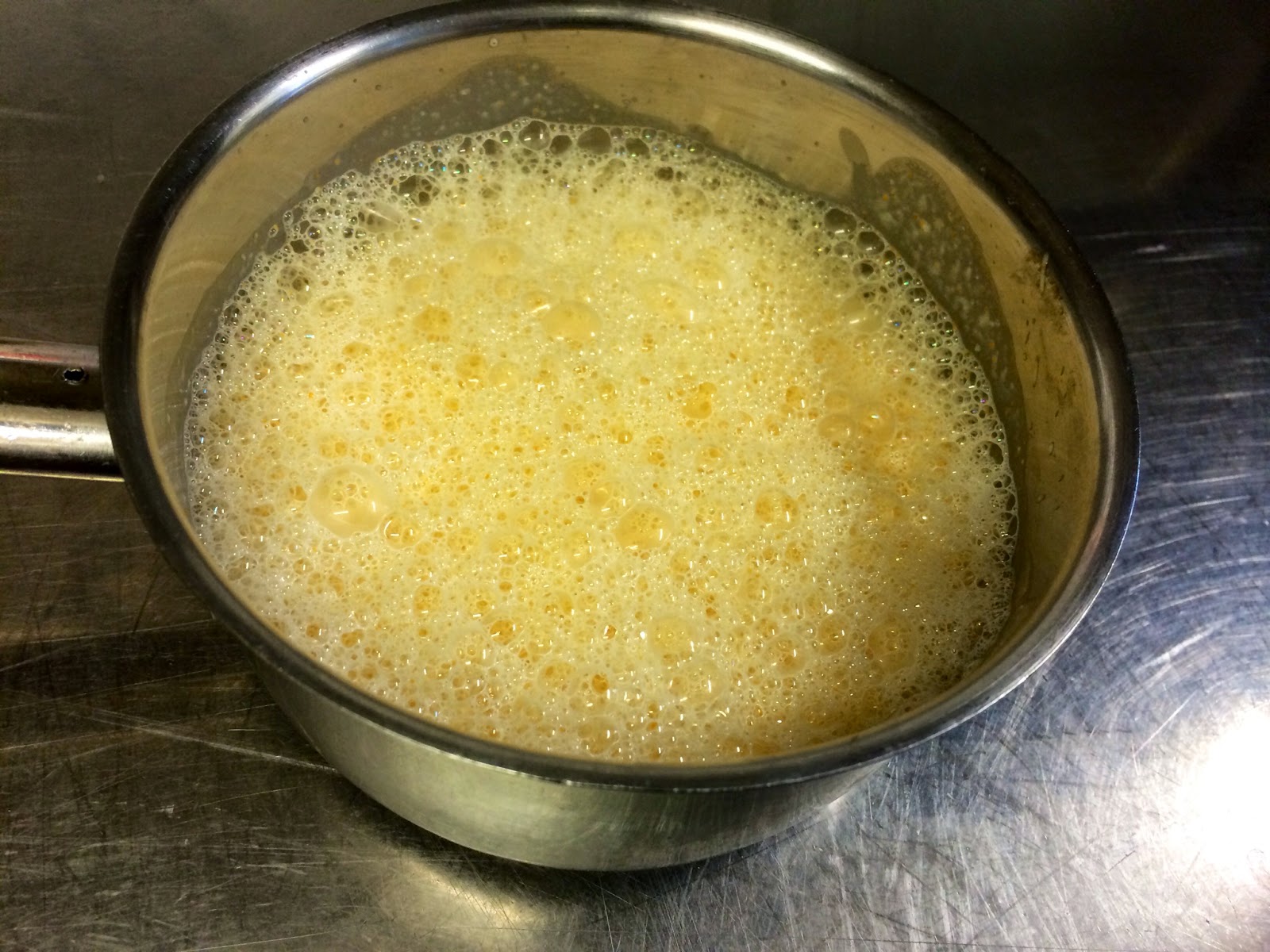
In a large pan sweat down the shallot, garlic, star anise & clove with 50g butter & olive oil and a pinch of salt. Once translucent add your vinegar and reduce by half, add white wine and reduce by half also. Add scallop roes and saffron and cook for 5 minutes. Add fish stock and reduce buy half then add cream and bring to the boil and take off the heat. Blend with Thermomix, or any other blender until smooth. Pass through a fine sieve to get rid of any bits so its pure. Add milk and pulse with a hand blender tilting the head of the blender up so you can froth the velouté producing a foamy topping to the sauce.

Monday, 7 April 2014

Elderflower Cordial

We still have at least a month or so to go until the elderflower is in bloom up here in Scotland but my excitement has tempted me to share my cordial recipe. This is great as a cocktail mixer in a summers drink or incorporated into a dessert to give that springtime elderflower essence.
Elderflower cordial:

50 Elderflower heads
2kg sugar
2 litre water
1 Lemon
2 limes
50g Ascorbic acid or vitamin C powder

Place the elderflower, lemon & limes into a tub whilst bringing the sugar and water to the boil. Add ascorbic acid to the simmering sugary water and stir until dissolved. Pour the warm liquid over the Elderflower and cover for 2 days. Once infused, pour the liquid through a muslin cloth and store in air carafe or kilner. This will keep for months on end in the fridge and is most definitely worth the effort.

Elderflower Vodka Cocktail:

50ml Kettle Vodka or 
25ml Elderflower cordial
Crushed Ice
Sparkling water
1/2 Juiced Lemon

Elderflower Spritzer:

  • Plenty of sliced cucumber
  • A half/three quarters/full bottle of white wine
  • 200 ml elderflower cordial
  • 3 mint (sprigs, leaves picked)
  • 1 litre of soda water

Wednesday, 2 April 2014

Wild Garlic Pesto

Wild Garlic pesto:

100g Fresh wild garlic leaf
40g Basil
40g Parsley
40g Spinach
50g Toasted pine nuts
50g Freshly grated Parmesan cheese
250ml Olive oil
Salt

You can make this one of two ways, the traditional way in a pestle & mortar or in a Blender, either way is good but using a blender will save a lot of time if your in a rush.

Firstly wash all your herbs by dipping them into a basin of cold water several times to make sure you have no beasties on them then pat dry with a cloth. Place your herbs into the blender and pulse until you have a course paste, don't make it too fine. Lightly toast off your pine nuts in a hot pan or in a hot oven, you're looking for a caramel colour. Try not take your eye off them, if they burn then they taste horrid. Place them into the blender with the parmesan and a pinch of salt and pulse again. Slowly add your olive oil bit by bit until you have the right consistency, your looking for a sauce but not a wet one; just a wet paste that falls down on the plate. Check the seasoning once more just to be sure your spot on.
If your a little wary with regards to nuts then by all means keep them out of the recipe, the French use this sauce a lot minus pine nuts. They call it Pistou & it comes from Provence.

This sauce can be used for a vast array of things from Pasta, potato salad, topping fish & even to top your soup with. Its a great flavour that can be used for almost anything. If stored correctly in an air tight tub in the fridge then it'll last a good 4 or 5 days.

Enjoy...

Monday, 31 March 2014

Poached Pear with Pear Cremeux, Hazelnut, Honey & Lemon Thyme.

This dessert has become one of my favourites over the winter and may see the light of day again sometime soon but until then it's in hold. However as it was a cracker I thought I'd share the recipe.


There are a few different components that are made in advance and it's all assembled to order to make it easier produce.

Poached pear:

4 Williams pears
1 ltr water
300g sugar
1/2 lemon

Honey Ice cream:

800ml milk
150ml cream
1 vanilla pod
150g honey
250g egg yolks

Pear Cremeux:

400g Pear puree
60g egg yolk
120g sugar
25g custard powder
2 gelatine leaf
250g butter
1 vanilla pod

To garnish:
Toasted hazelnuts (Crushed)
Lemon thyme leaves
Red vein sorrel
Honey
Ginger jelly

1. Bring the sugar & water to the boil then turn down the heat to low and add the 1/2 lemon and peeled pears, cover with a cartouche and slowly poach for roughly 15 minutes, check them after 10 with a skewer just incase they cook quick. Once ready then  cool on a tray and keep the liquid to place the pears back into to keep once everything is cold.

2. For the ice cream place the cream, milk, vanilla & honey in a pan and bring to the boil. Pour 1/3 of the liquid over the yolks & mix. Pour it back into the original milk mix and bring to 80*c while moving continuously to prevent it from scrambling. Cool down and freeze in a pacojet canister to be churned when required.

3. Boil pear puree, sugar & vanilla. Bloom the gelatine. Mix egg yolk & custard & temper it with 1/3 of the puree mix. Add back into the puree and bring to 80*c. Take off the heat, add the bloomed gelatine and whisk in the butter bit by bit so it doesn't split. Cool down and place into a piping bag.

To assemble cut your pear into wedges and place as you desire on the plate. Pipe some cremeux, its going to be a main component so don't be shy with it. Scatter a little roasted hazelnut, top with a nice spoonful of honey ice cream, a little ginger jelly, lemon thyme & sorrel.

Monday, 24 March 2014

Springtime Italian White Truffles


It's that time of year again when spring comes as a pleasant surprise and all us chefs get excited about all the fresh produce that comes into season. This week we got some fresh spring white truffles into work to play about with, don't be scared away with the thought of it being expensive tho as these were only 52p per gram; a bargain in our eyes. We rattled up a quick risotto recipe thats so basic, a child could make it; that doesn't mean it tastes like it!

Recipe:

500g Carnaroli super fino rice
2 diced shallots
2 clove Garlic
100g Butter
100ml white wine
2 litre nage (Veg stock)
20g french butter
30g parmesan cheese
2g truffle. 

In a warm pan, sauté the shallot & garlic in the butter with a pinch of salt. Once soft then add the rice and blast for 1 minute. Add white wine and cook down by half, this will be a fast process. Slowly add stock a ladle at a time moving the contents around the pan every so often. Don't be tempted to throw it all in at once as the rice won't cook evenly. Once all your stock is in the rice, check for seasoning then add the extra butter, some truffle and parmesan then check the seasoning again. Place into desired dish and top with a little more truffle. 

You can substitute the white truffle for black or even truffle oil. It comes in a lot of forms but our personal favourite is white.